
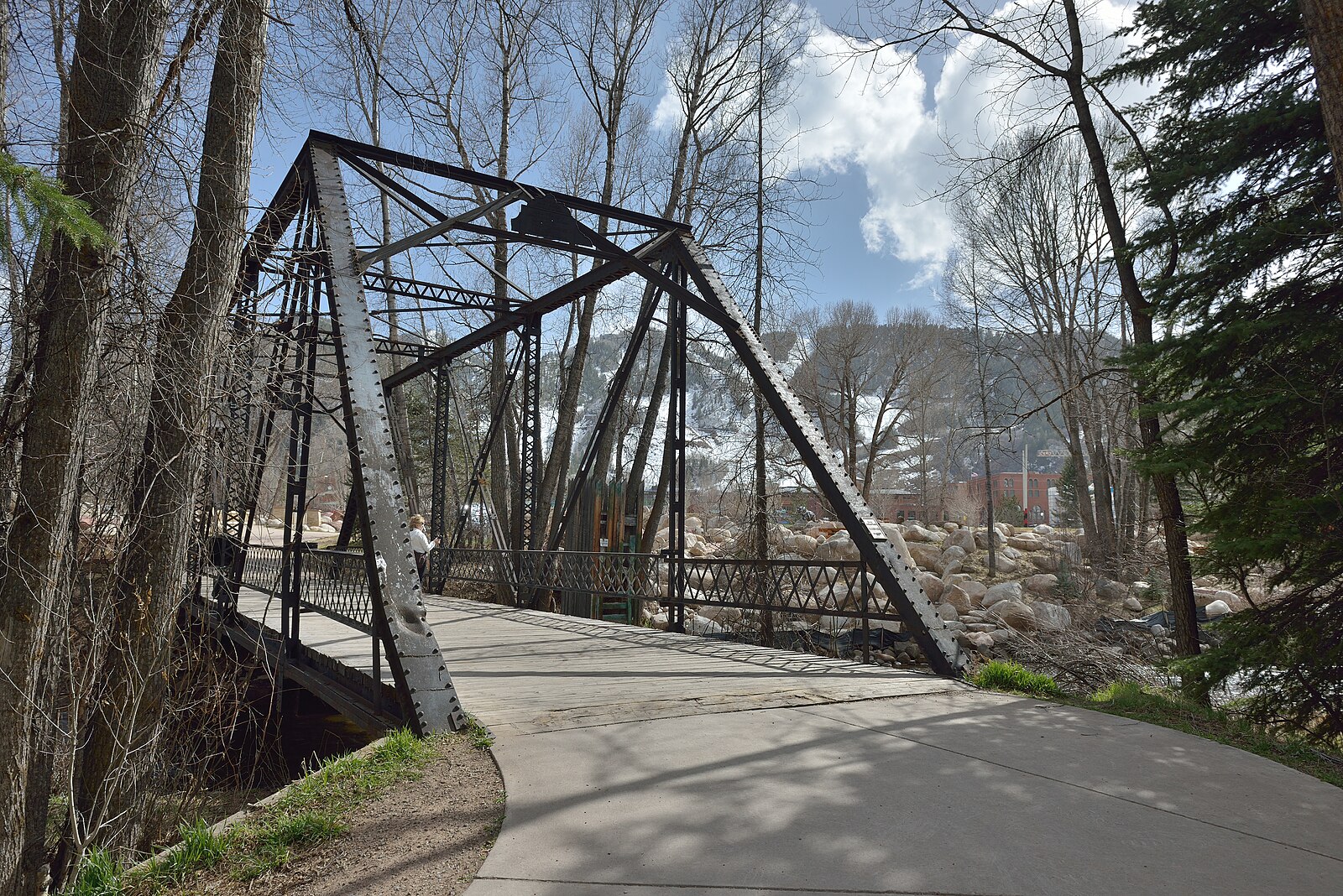
Sheely Bridge: Aspen’s Riveted Truss Legacy
In Mill Street Park, the Sheely Bridge Aspen stands as city’s earliest riveted truss bridge, built in 1911 and still linking the city’s industrial past with its preserved present.
Property Snapshot
-
Location: Mill Street Park, Aspen, CO 81611
-
Developer / Builder: Charles G. Sheely Construction Company
-
Heritage Designation: National Register of Historic Places (#85000223, listed in 1985)
-
Current Use: Pedestrian bridge
-
Year Built: 1911 Architectural Style: Pratt Through Truss (riveted steel)
-
Zoning: Parkland
Did You Know?
The Sheely Bridge was one of the first riveted truss bridges constructed in Colorado, built in 1911 at a cost of $6,300 and originally spanning 120 feet over the Roaring Fork River in Carbondale. Source: History Colorado
Why It Matters
The Sheely Bridge Aspen remains a rare physical link to the city’s early 20th-century transition from frontier roads to automobile infrastructure. Unlike historic silver-era buildings, its significance lies in industrial craftsmanship and adaptive reuse—reinforcing Aspen’s reputation for blending preservation with functional public space. For heritage real estate, it enriches community identity and parkside value..
History Through the Decades
-
1911: Built by Charles G. Sheely to carry State Highway 133 over the Roaring Fork River in Carbondale, replacing a deteriorated 1890s bridge; notable for its riveted construction—then cutting-edge technology—and priced at $6,300. Originally 120 ft long.
-
~1966: After 55 years of service, Sheely Bridge Aspen was replaced by a modern structure and relocated to Mill Street Park in Aspen; shortened by two panels to 87 ft.
-
1985: Listed on the National Register of Historic Places—one of just two Aspen bridges so honored (alongside Maroon Creek Bridge).
Over time, the bridge evolved from vital transportation infrastructure to a beloved pedestrian landmark, mirroring Aspen’s shift toward preservation-minded community planning.
Architectural Features
-
Design: Five-panel steel Pratt through truss design of Sheely Bridge Aspen highlights early engineering advances with riveted joints and laced members.
-
Structural Elements:
-
Top chord: Two channels with cover plate and lacing
-
Bottom chord: Four angles with continuous plate
-
Verticals & diagonals: Dual angles with spacers, plus laced two-channel verticals
-
Deck & support: Timber deck supported by steel stringers and cross beams
-
Substructure: Concrete wingwalls
-
Aesthetic detail: Latticework under guardrails—functional and period-accurate.
-
Explore Aspen’s Heritage
Discover more about Aspen’s heritage bridges and local preservation by visiting the Aspen Historical Society or History Colorado—and don’t miss the chance to explore the Smuggler Mine, where Aspen’s silver mining roots still come alive.
Q1:Why is Sheely Bridge Aspen historically significant?
A1:It’s the earliest surviving riveted truss bridge in Colorado and one of only a few remaining built by Charles G. Sheely.
Q2: When and why was it moved to Aspen?
A2: Around 1966, after being replaced in Carbondale, it was relocated to Aspen and shortened to serve today as a pedestrian bridge in Mill Street Park.
Q3: What makes Sheely Bridge Aspens’ architecture special?
A3: Its Pratt through truss with riveted joints, laced members, and lattice guardrails reflect early 20th-century engineering innovation and design detail.
Q4: How much did it cost originally, and does that include relocation?
A4: Original construction in 1911 cost $6,300; relocation costs are not specified in available sources.
Q5: Is it accessible to the public?
A5: Yes—it currently serves as a pedestrian bridge in publicly accessible Mill Street Park in Aspen.
Sources:
- Aspen Trail Finder
- Aspen Times / Aspen Historical Society
- Structurae (Engineering Database)
- Photo by Wolfgang Moroder, CC BY-SA 3.0, via Wikimedia Commons