
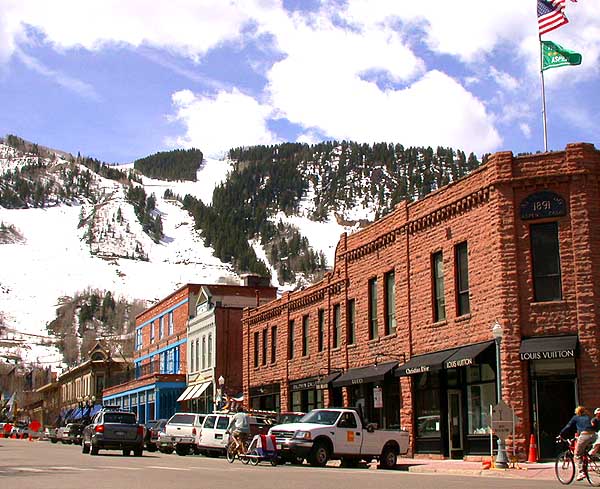
Rediscover Hyman–Brand Building Aspen History & Legacy
Step into Aspen’s layered past with the Hyman–Brand Building Aspen, a sandstone landmark built in 1891 that reflects both the city’s silver-boom ambitions and its glamorous reinvention nearly a century later.
Property Snapshot
-
Location: 203 South Galena Street, Downtown Aspen (corner of Galena & Hopkins)
-
Developer/Owner: David Marks Hyman (1891); later M.H. Brand (1920s); restored by Harley Baldwin (1971)
-
Historic Designation: National Register of Historic Places, listed January 18, 1985 (Ref# 85000085)
-
Current Use: High-end retail and cultural space, part of Aspen’s luxury “Glitter Gulch” shopping district
-
Year Built: 1891
-
Architectural Style: Late-19th-century Commercial Victorian with peachblow sandstone façade
-
Zoning: Downtown commercial/heritage retail
Did You Know?
In the 1920s, the Hyman–Brand Building Aspen was converted from a banking hall into a drive-through gas station—a striking example of how historic architecture adapted during the town’s mid-20th-century decline.
Why It Matters
The Hyman–Brand Building Aspen illustrates the city’s remarkable capacity for reinvention. Once a frontier bank, later an auto garage, and now home to luxury retail, it stands as a rare Victorian commercial block that survived boom, bust, and rebirth. Its preservation underscores the importance of adaptive reuse in historic Aspen real estate.
History Through the Decades
-
1891: Commissioned by investor David Marks Hyman, the Hyman–Brand Building Aspen housed the First National Bank and professional offices, symbolizing silver boom prosperity.
-
1893–1920s: After the Panic of 1893, Aspen’s economy collapsed, and the building entered a quieter period.
-
1920s: Acquired by M.H. Brand, the Hyman–Brand Building Aspen was repurposed for the automobile age, serving as a dealership and later a gas station.
-
Mid-20th century: The building deteriorated as Aspen languished economically, with demolition once considered.
-
1971 onward: Entrepreneur Harley Baldwin restored the sandstone façade of the Hyman–Brand Building Aspen and transformed it into Aspen’s most exclusive retail and cultural hub, anchoring the “Glitter Gulch” identity.
-
1985: Officially listed on the National Register of Historic Places.
Architectural Features
-
Rusticated peachblow sandstone walls sourced locally, giving the Hyman–Brand Building Aspen its distinctive presence
-
Clipped corner bay with angled entry, designed for heavy bank traffic at the intersection
-
Two-story pilasters dividing the façades into bays, lending Victorian rhythm and strength
-
Simple parapet roofline, consistent with late-19th-century commercial design
-
Preserved façade maintained during Harley Baldwin’s 1970s restoration, balancing heritage with modern retail use
Explore More of Aspen’s History:
Want to explore more Aspen heritage treasures? Discover how landmarks like Hyman–Brand Building Aspen shape the city’s cultural identity —National Register of Historic Places Nomination – Brand Building (NPS.gov PDF)
Q1: What was the original purpose of the Hyman–Brand Building Aspen?
A1: It was built in 1891 to house the First National Bank of Aspen and professional offices.
Q2: Why is it called the Hyman–Brand Building Aspen?
A2: David Hyman commissioned it in 1891, and M.H. Brand later converted it for auto uses in the 1920s.
Q3: How did the Hyman–Brand Building Aspen adapt during the town’s decline?
A3: The former bank lobby was converted into a drive-through gas station, serving Aspen’s limited automobile trade.
Q4: Who saved the Hyman–Brand Building Aspen from demolition?
A4: Harley Baldwin bought and restored it in 1971, repositioning it for luxury retail and cultural use.
Q5: When was the Hyman–Brand Building Aspen added to the National Register?
A5: On January 18, 1985, with reference number 85000085.
Sources:
-
National Register of Historic Places Nomination – Brand Building (NPS.gov PDF)
-
Aspen Journalism – Mailbox Money: Aspen’s Most Valuable Retail Buildings
- Photo by Matthew Trump via Wikimedia Commons, licensed under CC BY-SA 3.0